Miners' Dugouts
A passport key (from the Burra Visitors Information Centre) will be required for entry
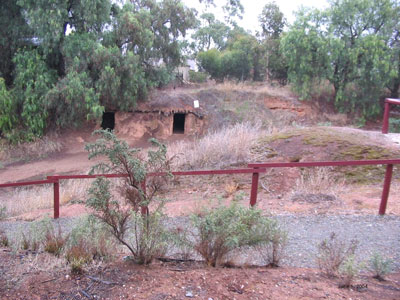
With a rapid influx of miners to the mine in the mid 1840s there was an acute shortage of housing in the newly laid out company township of Kooringa. The miners provided their own housing by digging into the soft clay banks of the Burra Creek. The first of these creek dwellings being dug in 1846. They were favoured by the miners, being rent free and close to water.
In 1851 about 1,800 people in a total population of 4,400 lived in nearly 600 of these dugouts. In 1851, three floods devastated ‘Creek Street’ driving the inhabitants from their homes. The South Australian Mining Association (SAMA) refused to provide flood relief to the dugout residents, and prohibited the company from hiring anyone living in the creek bank — a policy that effectively ended new construction. Some families remained, but a great flood in 1859 swept through the surviving dugouts and expelled the last residents. By 1860 the dugouts were virtually deserted.
The dugouts were ingenious dwellings for a place where shelter was urgent and materials scarce. To ventilate a fireplace, a shaft was bored upward through the earth to the surface, and a wooden flour barrel was embedded vertically in the shaft to form a serviceable chimney. These barrel chimneys — low wooden tubes protruding from the grassy bank — were a distinctive feature of Creek Street life. They were also a hazard: residents capped them with casks to stop nocturnal travellers stumbling into the chimney openings, and one man walking home from the pub fell through the top of a barrel chimney and landed in Mrs Nankervis’s kitchen fireplace.
Three dugouts have been restored by the National Trust as a tourist attraction.
For the full story of Creek Street and its people, see Creek Street: Life and Death in the Burra Dugouts (workshop draft).